

 All Posts
Last updated on March 5, 2026
London is often framed as the ‘conservative’ choice for tech IPOs. Neil Shah, Head of Tech for Primary Markets at the London Stock Exchange, explains how the data and the founder outcomes tell a very different story.
London offers a credible IPO route, yet it’s often unfairly viewed as less glamorous than the US, where perceptions of higher multiples and deeper liquidity endure.
The reality is more nuanced – and far more encouraging. London is one the world’s leading public markets – with companies raising over £2.1b at IPO in 2025. UK tech IPOs have delivered outcomes that compare favourably with the US. But to see that clearly, you need to look beyond the headlines and instead focus on ownership, how value builds over time after listing, and the stories behind the tickers.
✗ Myth 1: London Limits Founder Upside
✔ Reality: London has delivered founder value at scale
A common belief is that listing in London means diluting too early – giving up control before a company has had the chance to really grow. In reality, some of the strongest founder outcomes in UK tech have come from businesses that chose to list earlier, while there was still plenty of value left to build, and then compounded that value whilst scaling.
Alpha Group International is a good example of how that can work.
After launching and selling an online social poker league, Poker Project, Morgan Tillbrook founded FX and financial services firm, Alpha, in 2011. When the company went public on AIM in April 2017, it was still relatively early in its journey: around £8.5m of revenue, roughly 30 people, and a single office. This wasn’t a company coming to market to cash out; it was a founder using public markets as a platform to scale.
The IPO was structured to preserve meaningful founder ownership and long-term alignment. What followed was steady, deliberate expansion: new markets, a broader product range, and a business that grew into a genuinely global operation. In 2025, Alpha was acquired by Corpay in a $2.4 billion deal.
By then, Alpha was generating around £170m in annualised revenues and employed more than 500 people across 11 international offices.

✗ Myth 2: UK Public Markets Lack the Patience for Tech
✔ Reality: Long-term compounding is one of London’s strengths
Another assumption founders often raise is that UK public markets lack patience. Cerillion’s journey suggests the opposite.
It was founded by Louis Hall who led a management buyout from Logica in 1999. After a period of private backing from firms including Baird Capital WestLB Panmure (acquired by what now is Molten Ventures), the company went public on the London Stock Exchange’s junior market, AIM, in 2016 at 76p per share. It builds billing and customer management software for telecoms operators – the kind of software that is deeply embedded, critical, yet rarely headline-grabbing.
What Cerillion has done since is quietly impressive. Today, its shares trade at around £16, with founder ownership still over 20%. The business has grown steadily, expanded internationally, and generated strong cash flows, supported by investors who understand the model and are comfortable backing disciplined execution over the long term. This kind of patient compounding is not unusual in London’s public tech market. Investors here are structurally set up to back companies of all sizes, not just those worth more than $10b, – which is exactly what disciplined B2B software companies need.
✗ Myth 3: Serious Software Businesses Need US Markets
✔ Reality: London backs credible, cash-generative tech at scale
Many founders believe that operating in the US inevitably means listing there. The assumption is that London is fine for regional businesses, but not for global businesses.
However, London consistently funds globally ambitious companies, including those focused in the US. It’s one of the top global exchanges for capital raised, consistently outperforming other European markets, and it’s growing. The £2.1b raised at IPO in London in 2025 was almost triple the amount raised the previous year.
Also, more than 90% of capital raised in London in 2025 was by companies raising follow-on funding to fuel their growth.
When you look at how easily publicly available shares can be traded, London and New York are broadly comparable. Meanwhile, UK listing costs, litigation risk and regulatory burden remain lighter than the US.
Craneware shows this in practice. CEO, Keith Neilson took the company public in London in 2007 with around $15m of revenue. From the outset, the company was focused on the US healthcare sector – one of the most complex, regulated, and demanding customer landscapes globally. This is exactly the kind of business many founders assume needs a US listing to be taken seriously.
Instead, Craneware scaled a predominantly US-facing business while remaining listed in the UK, growing annual recurring revenues to over $200m and embedding its software deep within hospital financial and operational systems. London investors consistently backed that strategy, providing the capital and stability required to compete in one of the world’s most demanding markets.
✗ Myth 4: Niche markets struggle in London
✔ Reality: Category leaders often thrive
Concerns that a concept is too specialised, or too niche, to attract attention in London are also not true in practice.
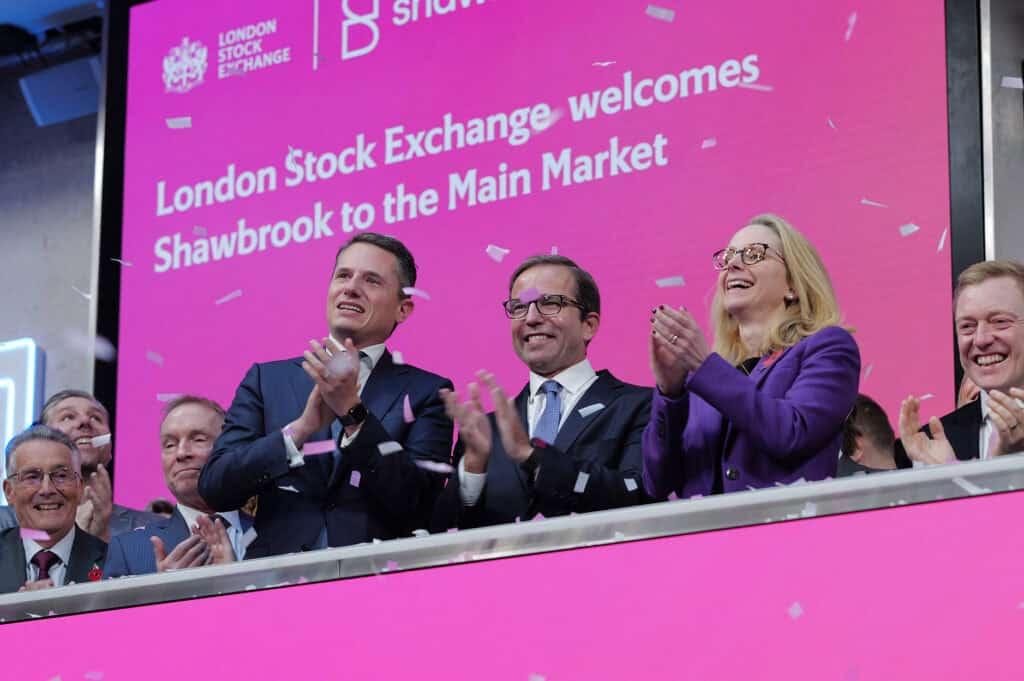
Shawbrook Group, a bellwether for many FinTechs, returned to public markets on 30 October after eight years in private equity hands, achieving a £1.9b valuation on its IPO. The specialist bank serves over half a million customers across the UK, focusing on SMEs, real estate, and retail lending. Since 2013, Shawbrook has lent over £37b to customers. It raised £347.8m, and with an increasing demand for specialist funding, there’s a huge opportunity for further growth. This was a particularly strong IPO for London with a book of demand that was over 7x oversubscribed, with 40% of new investors originating from North America.
The Bottom Line
Public listings don’t guarantee success, but the idea that London doesn’t work for tech founders doesn’t hold up when you look at the evidence.
The London Stock Exchange has enabled founders to raise capital, retain control, build liquidity gradually, and deliver outcomes that stand up well against US comparables.
And for those who want to remain private for longer, the new Private Securities Market – built on the UK Government’s PISCES framework – allows private companies to access public-grade infrastructure for periodic liquidity, giving founders even more flexibility in how they scale.
Whatever the focus of their business, London has repeatedly shown it can support specialist, founder-led businesses that define their own categories and drive their growth over time.
If you’re interested in leveraging this platform for your company, contact Neil Shah, Head of Tech Sector at the London Stock Exchange team or visit their website to learn more.