
 All Posts
Last updated on November 19, 2025
Our 13th edition of FF North America brought together over 300 of the world’s top tech leaders to discuss AI agents, computational democracy, and the future of enterprise transformation. Get the full lowdown here.
As AI agents move from hype to reality and founders grapple with crazy business transformations, we brought together the brightest minds to address the most pressing questions facing tech founders today.
Our 13th annual edition of FF North America in New York brought together nearly 100 unicorn founders from 17 countries. Over the weekend, we heard from trailblazing entrepreneurs, investors, and policymakers spanning healthcare, AI infrastructure, defence tech, and more.
Meredith Whittaker (Signal Foundation) and Rony Abovitz (Synthbee) explored the choice between computational democracy and autocracy, while Arianna Huffington (Thrive Global), Greg Case (Aon), and Linda Yaccarino (CEO, eMed) discussed the GLP-1 revolution transforming wellbeing. Tony Fadell (Build Collective) and Kevin Ryan (Alleycorp) shared their investment philosophies and lessons from decades of company building.
Dara Khosrowshahi (Uber) took us through Uber’s autonomous vehicle strategy and the next era of mobility, Wyclef Jean and Oscar Hoglund (Epidemic Sound) explored where music meets machine, and Noubar Afeyan (Flagship Pioneering) explained the art of moonshot thinking that created the mRNA vaccine.
Here are our five key takeaways from FF North America 2025:
1. AI Agents Are Entering Businesses, But Real Implementation Remains Hard
We know that AI hype is a thing. Yet, 95% of Gen AI pilots fail. The challenge isn’t technology and innovation, it’s change management, system integration, and proving measurable value.
True AI agents that complete end-to-end tasks without human intervention are still emerging. Most current agents handle small tasks before requiring human handoff, so it’s clear that success requires hyperspecialisation: target high-value, low-risk deployments first with measurable ROI.
Companies like Minna Song’s EliseAI are thriving by focusing on industries that largely skipped the SaaS generation – residential real estate and healthcare providers – where AI can deliver complete task solutions to non-technical users. Meanwhile, Niraj Shah’s Wayfair is adopting AI across volume-based work like product catalogue completion and customer queries.
2. The Battle Between Computational Democracy and Autocracy Will Define Our Future
The Big Tech companies now represent over 75% of US GDP – an unprecedented concentration of power built on AI and compute foundations. This creates a choice: large, autocratic hyperscaler systems, or distributed, human-centric systems that preserve individual agency.
There are basically two app stores and three hyperscalers now dominate the market. This is of course concerning for security, as AI agents integrated into operating systems could threaten user privacy.
The alternative? Founders urged that AI should be designed to help humans, not replace them. Think bounded, specific tools rather than all-knowing systems.
The current AI paradigm isn’t inevitable. Smaller, domain-specific models often outperform large general models in real-world applications. The question for founders is: will you build systems that elevate or diminish human agency?
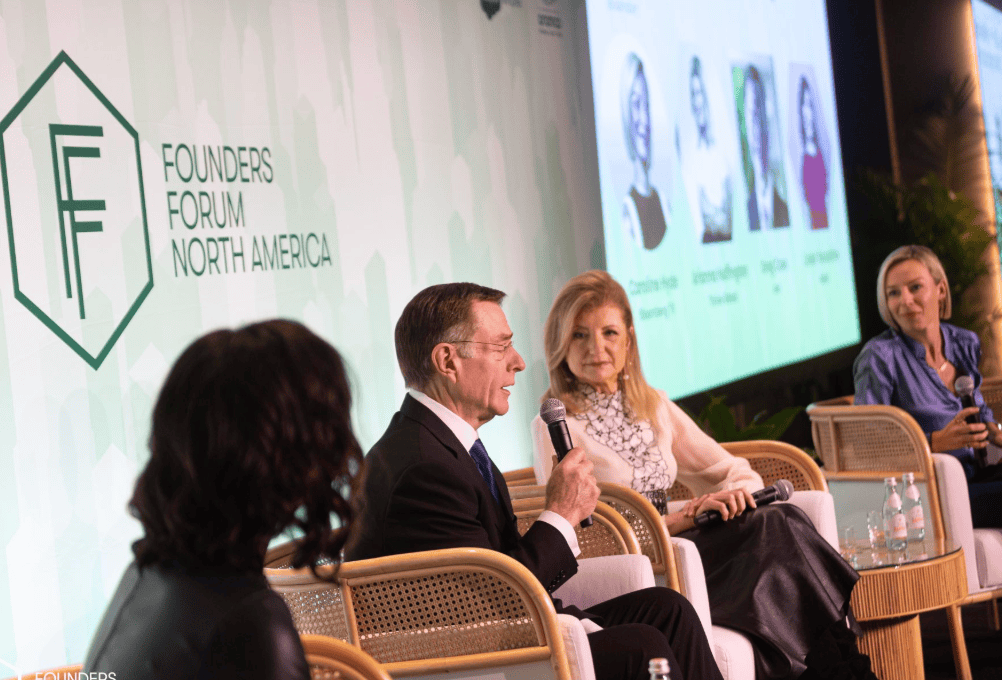
eMed’s Linda Yaccarino, Aon’s Greg Case, Thrive Global’s Arianna Huffington, and Bloomberg TV’s Caroline Hyde at FF North America 2025.
3. Exit Strategy Matters More Than You Think
Despite the unicorn success stories dominating headlines, the statistical reality is sobering: lots of founders end up with nothing at exit. Many late-stage startups demonstrate the downside protection gap when market conditions shift. Companies with large valuations during peak markets can be acquired for significantly less – investors may successfully exit through their liquidation preferences while founders and employees receive minimal or no proceeds despite years of building the business.
When we compiled the UK’s top 50 exits, we saw that board and investor alignment is crucial for founders navigating the process. Company setup philosophy differs significantly between “never exit” and “planned exit” mentalities, affecting everything from capital structure to long-term funding needs.
4. Healthcare Is Being Revolutionised by GLP-1s
We’re witnessing the most consequential healthcare intervention in history. US healthcare costs represent nearly 18% of GDP, yet population health has been deteriorating. However, for the first time, populations are improving health while the cost curve is downward.
This is due to the impact of GLP-1s, drugs that mimic a natural hormone to help manage type 2 diabetes and obesity. Aon’s study of 50 million people showed that, whilst initial costs increased as better healthcare leads to more doctor visits and illness discovery, but after 24 months the cost curve decreased. Results include 44% reduction in cardio events, delayed diabetes onset, and benefits affecting 49-65% of the US population aged 50+.
Linda Yaccarino’s eMed reduces costs by providing at-home test kits with live proctors, FDA-approved medications, and weekly accountability check-ins. Saeju Jeong’s Noom adds behaviour change methodology focused on five foundational behaviours: food, exercise, sleep, stress, and connection. Clearly, the health revolution relies on innovation, effective clinical delivery, and behaviour change.
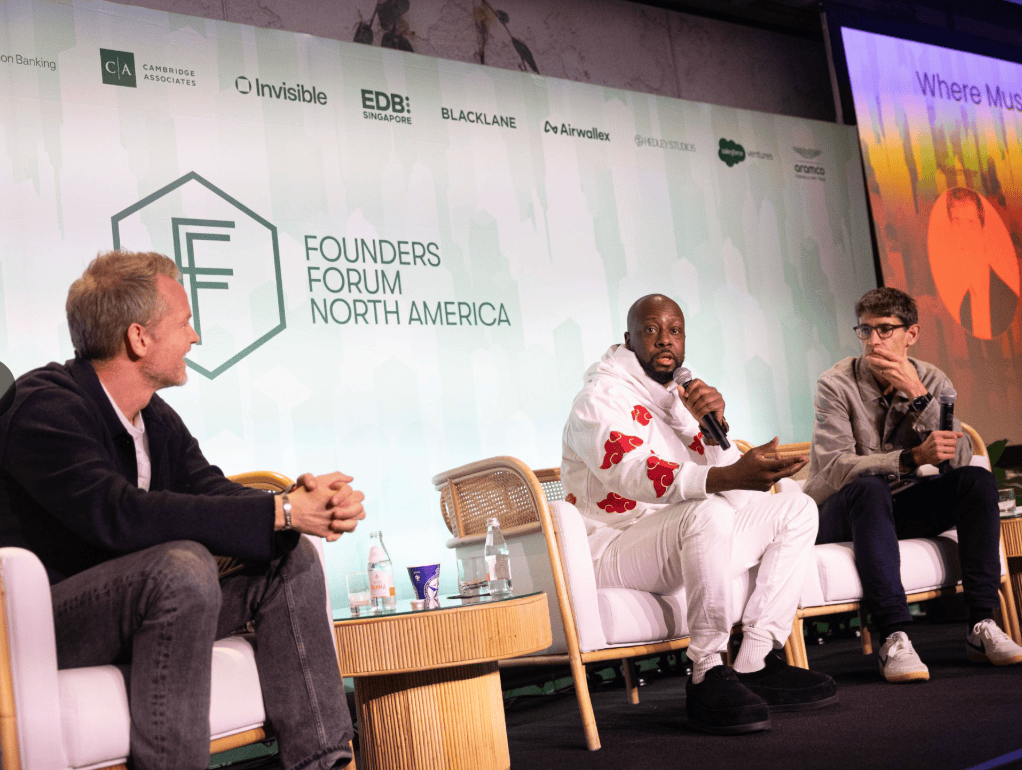
Epidemic Sounds’s Oscar Hogland, and Wyclef Jean, and The Atlantic’s Nicholas Thompson, at FF North America 2025.
5. Infrastructure and Energy Constraints Are the Real AI Bottlenecks
Forget the AI model debates – the actual constraints are hardware, energy, and infrastructure. We’re running out of high-quality training data, but the harder constraint is energy: AI demand is outpacing grid capacity, and new power projects take 3-5 years to deploy.
The implications are enormous. On the energy frontier, Will Regan’s Pacific Fusion is targeting net-energy gain by 2030 with a system that’s over 200x more land-efficient than wind and uses under 1% of its land footprint. If fusion becomes viable, the first country to scale it becomes the dominant energy superpower – and China has already invested nearly $13b into fusion in the past two years.
On the compute side, Tim Davis (Modular), Vipul Ved Prakash (Together AI), and Will Manning (Spiral) are building toward a heterogeneous hardware future: CPU + GPU + NPU combinations with unified compute layers that abstract hardware complexity.
That’s a wrap from FF North America until next year. Big thanks to our partners, Dubai Economy & Tourism, BCG, HSBC Innovation Banking, EDB Singapore, Invisible, Blacklane, Airwallex, Cambridge Associates, Accumulator, incode, aramco, Salesforce Ventures, and Hedley Studios.
Click here to learn more about our Founders Forum North America.