

 All Posts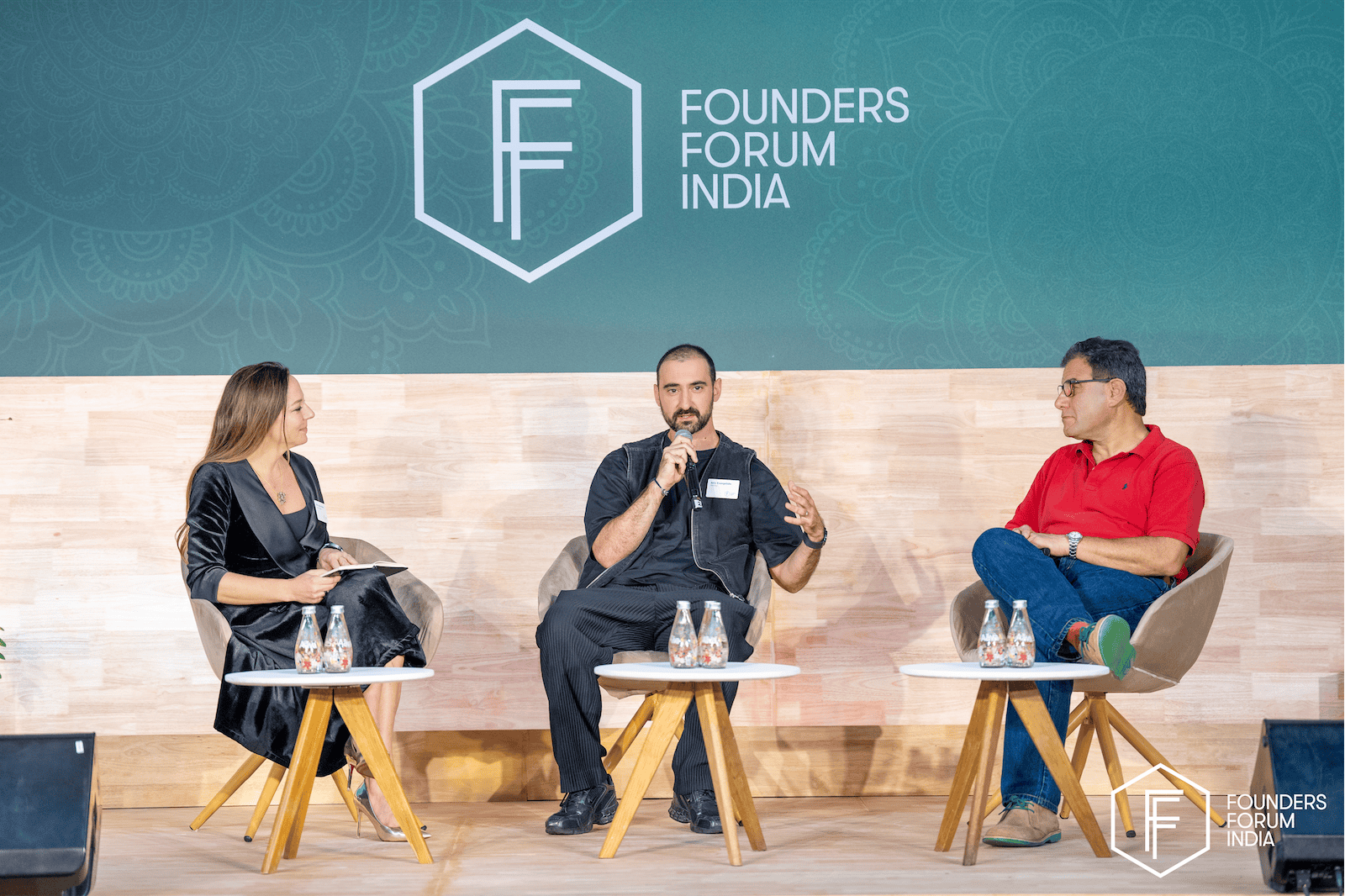
Last updated on March 5, 2026
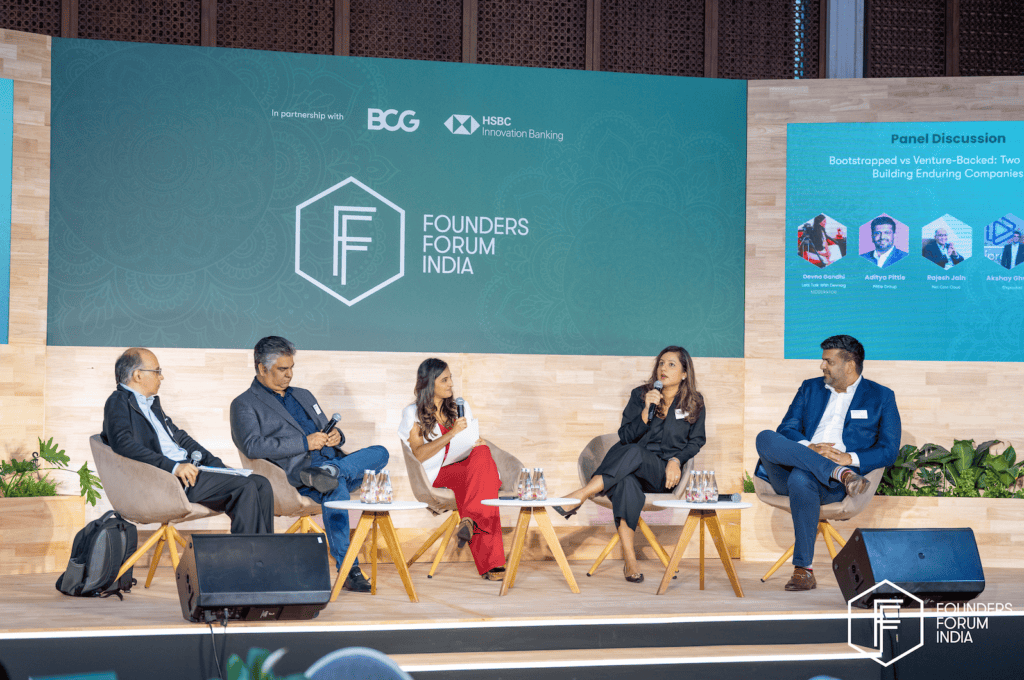
At Founders Forum India, founders and investors showed that building startups in India has fundamentally changed. Discussions broke down what’s different, and what it means for anyone building in the region now.
For the best part of a decade, the ambition driving India’s tech ecosystem was to become a unicorn, quickly. Raise big, grow fast, grab market share, raise again, and so on.
What’s replaced the old rulebook is one harder to execute, less glamorous, and far more durable. Last week, at Founders Forum India, we touched down in Mumbai to gather tech leaders who are leading the charge – among them Cobra Beer’s Lord Karan Bilimoria, who has navigated India’s complex consumer market for three decades, and Vitabiotics’ Tej Lalvani, who is expanding the brand’s footprint here now, and many more.
Over the course of the day, we kept hearing the phrase ‘the right to win’ – the importance of building something that earns its customers, compounds over time, and survives the inevitable down cycles. Here’s what that means in practice.
Why India’s Top Startups Stopped Chasing Unicorn Status
India minted 41 unicorns in 2021. Rounds were closing every six months. Valuations hit 80x, 100x forward revenue. The assumption baked into every pitch deck was that more capital would always be available – so burning through the current round was fine, because the next one was already coming.
When Covid hit, companies valued at hundreds of millions went to zero practically overnight. Companies that looked unbeatable turned out to be propped up by FOMO and transient capital rather than fundamentals. When the money stopped, so did the growth.
‘After that,’ one investor said, ‘substance mattered more than capital deciding valuation. Substance in revenue, substance in profitability.’ Serious founders have to ask themselves: What’s my real right to win in the market space? What’s my reason for being here?

What Entrepreneurs in India Are Optimising For Instead
The businesses that survived that period, and the ones investors at FF were most excited about, share a common characteristic. They built deep before they built wide.
Take the consumer companies – the ones that held their public market valuations were the ones that had figured out their unit economics before they scaled, resisted the temptation to discount their way to market share, and built real customer trust.
One founder described the trap clearly: “When you discount, you capture market share in the short term. But your price base normalises, your product quality depreciates.” You’ve compromised the one thing you actually stand for.
This is the core tension that the 2021 boom exposed. Capital can accelerate a good business, but can also mask a broken one. The founders who survived learned to distinguish between the two. The investors who survived learned to ask harder questions earlier.
For founders building today, the metrics that matter have shifted. Growth rate still matters. But increasingly, investors are asking: can this business explain why it has the right to win its specific market? Can it survive without the next round? Does the unit economics work at scale, not just in a spreadsheet?
Where India’s Top Startups are Building Now
The shift towards discipline has redirected ambitions for entrepreneurs scaling in India. A new wave of Indian startups – manufacturing companies, space tech startups, biotech ventures, deep tech founders – are building things that have no quick fix, and an atypical venture timeline.
The capital to back them is increasingly there. Domestic family offices are becoming increasingly integral in the region’s early-stage funding, bringing a different kind of knowledge than foreign VCs – they’ve built businesses in India and understand what it takes.
Government initiatives like the ₹1 lakh crore Research and Development Fund are creating catalytic capital for deep tech. And investors who previously focused entirely on asset-light internet businesses are actively moving into manufacturing, robotics, and energy.
If you’re building something hard and you have a genuine right to win it, the capital is available. The bar is higher. But so is the appetite.
The shift is just as visible across sectors. Insights from FF India showed that Pocket Aces’ Aditi Shrivastava has built a digital entertainment company for India’s 400m+ online users by going local – not national. And Huma’s Dan Vahdat is building AI-driven digital health tools designed to scale globally, but rooted in India’s fast-digitising health data.
Why India’s Top AI Startups Are Betting on Fragmentation and Thinking Long Term
That appetite demands that founders understand something that trips up almost every India startup trying to build at national scale: India isn’t a single market. It’s closer to twenty.
Languages, cuisines, price sensitivities, buying behaviours – they shift every few hundred kilometres. A food-tech founder in our community put it well. “It was always easy to standardise,” they told us, “but with AI, it’s now easy to customise.” Today they’re in 120 cities, with ambitions to reach 300 within a year – using data and demographics to decide not just where to open, but which brand to open with.
A content founder made the same point: “[India] is not homogenous, and what’s worked is a decentralised approach — working with Bhojpuri, Gujarati, Punjabi, Telugu, Kannada, and Tamil creators to build content specifically for those cultural markets.” You can’t parachute in with a metro-centric lens and expect tier-two India to follow.
The founders who understand this are thinking in decades, not funding rounds. India’s GDP crossed $1t in 2007, $2t in 2014, $3t in 2021, and $4t last year, with projections of $8t by 2030.
Coming from a room full of people building rockets, water infrastructure, and AI-powered healthcare platforms, India’s most exciting chapter is clearly still ahead.
Click here to register your interest for Founders Forum India 2027.